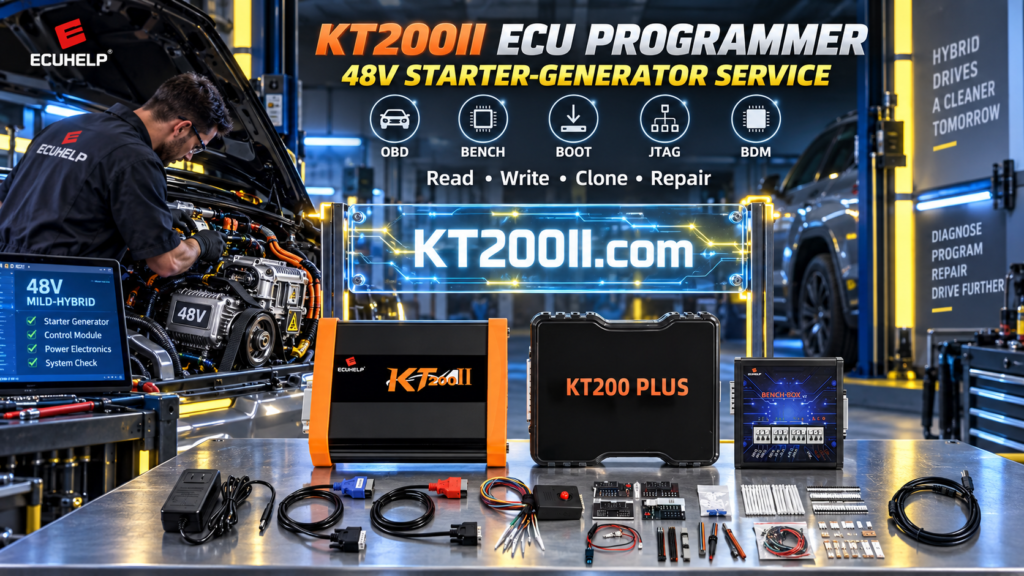
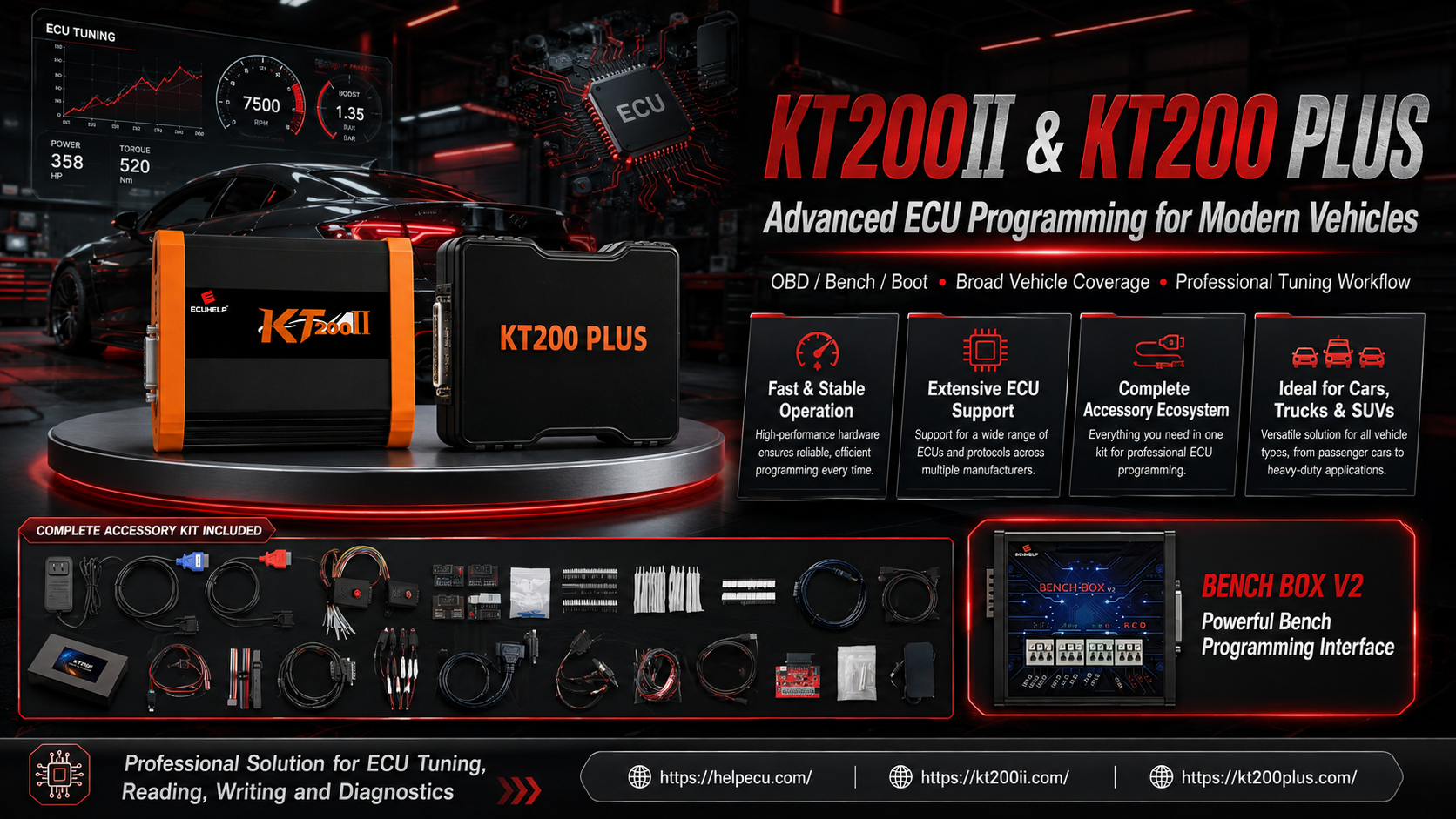
KT200 Plus Bosch MD1 & MG1 Programming Guide: Protocol, Backup, Bench and Boot
A practical guide for professional technicians working with supported Bosch MD1 and MG1 ECUs using KT200 Plus, covering ECU identification, protocol selection, programming modes, original-data backup, file verification and recovery preparation.
Bosch MD1 and MG1 control units are increasingly important ECU families in modern vehicle programming, repair and calibration work.
For technicians using KT200 Plus MD1 MG1 protocols, the most important point is that “MD1” or “MG1” alone is not enough information to select a programming procedure.
The complete ECU family, vehicle application, hardware revision, software identification, processor and supported programming method must be checked before connecting the tool or loading a file.
For example, two ECUs carrying an MG1 designation may belong to different vehicle manufacturers, use different hardware or software generations and require different KT200 Plus protocols.
The same principle applies to Bosch MD1.
This guide explains a structured workflow for identifying Bosch MD1 and MG1 ECUs, selecting the correct KT200 Plus protocol, choosing the appropriate connection method and protecting the original ECU data before programming.
Can KT200 Plus Program Bosch MD1 and MG1 ECUs?
KT200 Plus provides programming protocols for supported Bosch MD1 and MG1 ECU applications. The exact identification, Read, Write, backup, cloning and connection functions depend on the specific controller and protocol. Always search the complete MD1 or MG1 ECU model and confirm the available operation before programming.
Why “MD1” or “MG1” Is Not Enough
Bosch MD1 and MG1 are broad control-unit families rather than single universal ECU models.
The suffix following MD1 or MG1 is important because it helps identify the specific controller generation and vehicle application.
A professional KT200 Plus programming job should therefore begin with the complete ECU identity.
| Information | Why It Matters | Recommended Action |
|---|---|---|
| Complete ECU Family | Different MD1 / MG1 variants can use different protocols. | Record the full controller name. |
| Vehicle Application | One ECU family may appear across several manufacturers or engines. | Record make, model, year, engine and region. |
| Hardware Number | Helps distinguish electronic revisions. | Save the complete ECU identification. |
| Software Number | Important when matching original or modified files. | Compare before every Write. |
| Processor / MCU | May affect programming access and recovery procedures. | Confirm against the exact protocol. |
| Programming Mode | Available access can differ between OBD, Bench and Boot. | Follow only the supported method. |
Use the KT200 Plus protocol database and search the complete controller family, such as a specific MD1 or MG1 variant, rather than searching only “Bosch” or the vehicle manufacturer.
For a complete protocol-selection workflow, read the KT200 Plus Protocol Search Guide.
Bosch MD1 vs MG1: What Should a KT200 Plus User Check?
From the programming technician's point of view, the most important question is not simply whether the controller is called MD1 or MG1.
The important questions are:
- What is the complete ECU family?
- Which vehicle uses this ECU?
- Which processor or MCU is installed?
- Which KT200 Plus protocol matches it?
- Which connection method is available?
- Which memory areas can be read?
- Which Write operation is supported?
- Is a complete backup available?
- What file format does the selected operation require?
Identify the Controller, Not Just the ECU Family
Treat MD1 and MG1 as starting points for protocol research. The final programming decision should be based on the exact controller, processor, vehicle application and operation listed in KT200 Plus.
KT200 Plus MD1 MG1 Programming Modes
Depending on the exact supported protocol, a Bosch MD1 or MG1 programming job may use vehicle-side or direct ECU communication.
Do not select a mode simply because it was successful on another MD1 or MG1 ECU.
| Mode | Connection | Main Advantage | Main Check |
|---|---|---|---|
| OBD | Vehicle diagnostic connector | Controller can remain installed when supported | Confirm exact available Read / Write operation |
| Bench | Direct connection to ECU connector | Controlled direct communication | Verify pinout, voltage, ground and communication wiring |
| Boot | Direct connection with board-level access where required | Deeper processor or memory access | Verify processor, board diagram and exact Boot procedure |
| JTAG | Processor debugging interface on supported controllers | Advanced direct memory access | Confirm exact adapter and connection diagram |
Read the KT200 Plus OBD vs Bench vs Boot Guide before choosing a connection method.
KT200 Plus MD1 MG1 OBD Programming
When the exact protocol provides the required OBD operation, vehicle-side programming can reduce disassembly and preparation time.
However, an OBD option should never be assumed simply because another ECU from the same family supports it.
Before an OBD Operation
Save all available hardware, software and calibration information.
Check exactly what Read and Write operations the selected protocol provides.
Maintain suitable vehicle power throughout identification, reading and writing.
Preserve every original file made available by the selected protocol.
KT200 Plus MD1 MG1 Bench Programming
Bench Mode is commonly used when the supported protocol requires direct communication with the ECU outside the vehicle.
The control unit is connected through its external connector using the specific KT200 Plus wiring diagram for that ECU.
Do not reuse an MD1 or MG1 pinout simply because another ECU has a similar connector or housing. Confirm the exact protocol and connector orientation before applying external power.
Verify the Entire Bench Connection
- Permanent positive supply
- Ignition or wake-up supply where required
- Ground terminals
- CAN High and CAN Low
- Other protocol-specific communication lines
- Connector orientation
- External power-supply settings
- Programming harness connection
For power preparation, see the KT200 Plus Bench Power Supply Guide.
When Should Boot Mode Be Used on MD1 or MG1?
Boot Mode should be used only when the exact KT200 Plus protocol and required operation call for processor-level or deeper memory access.
Depending on the ECU, this can require opening the controller and connecting to designated board-level points.
If the required operation is fully supported through OBD or Bench, moving directly to Boot usually adds unnecessary physical work and risk. Follow the least invasive supported method that provides the required data.
Before Opening a Bosch MD1 or MG1 ECU
- Confirm the complete ECU model.
- Confirm the processor or MCU.
- Confirm the exact KT200 Plus protocol.
- Review the complete board diagram.
- Confirm the Boot, reset or other required connection points.
- Prepare stable external power.
- Prepare a clean and static-aware working area.
- Understand the required power sequence.
What Should You Back Up Before Writing?
Before changing customer ECU data, save the identification information and every original memory area available through the exact KT200 Plus protocol.
The files available on one MD1 or MG1 protocol should not be assumed to be identical to those available on another.
Save hardware, software, calibration and available part-number information.
Preserve the supported program or calibration memory before modification.
Save separately when the exact protocol provides EEPROM access.
Preserve processor-related data when supported and relevant to the operation.
Use the protocol-specific full-backup option when it is available.
Keep ECU photographs, protocol screenshots and original file names with the job.
For a complete backup workflow, read the KT200 Plus ECU Backup Guide.
Keep the Original MD1 or MG1 File Untouched
The first verified read should be treated as the master original file.
Do not edit the only copy.
| File | Purpose | Recommended Handling |
|---|---|---|
| Original Master | Reference and recovery | Never edit |
| Working Copy | Authorized calibration work | Use a different filename |
| Final Write File | Data programmed to ECU | Store with exact job information |
| Recovery Reference | Known-good restoration reference | Keep separately |
How to Verify an MD1 or MG1 File Before Writing
A filename containing “MD1” or “MG1” does not prove that the file belongs to the ECU on the bench.
File size alone is also not enough.
Complete ECU family
Hardware number
Software number
Vehicle application
Memory area
File size
Read / Write format
Checksum workflow
KT200 Plus MD1 MG1 Checksum Preparation
Checksum verification is part of file preparation, but a correct checksum does not automatically mean that a file is compatible with the connected ECU.
Compatibility must be checked first.
ECU identification → hardware and software matching → memory area → file format → file size → checksum workflow → supported Write operation.
Read the KT200 Plus Checksum Guide for a more detailed file-verification workflow.
Professional KT200 Plus MD1 MG1 Workflow
Record the Vehicle
Save vehicle manufacturer, model, year, engine and the required programming operation.
Photograph the ECU Label
Capture the complete Bosch and OEM identification before connecting the tool.
Search the KT200 Plus Protocol
Find the exact MD1 or MG1 variant and compare the processor and available operation.
Confirm OBD, Bench, Boot or JTAG
Use only the connection mode listed for the required programming function.
Prepare Stable Power
Prepare vehicle battery support for OBD or a suitable external supply for direct ECU work.
Read ECU Identification
Save the available hardware, software and calibration information.
Read the Original Data
Save every available original memory area required for the job.
Verify the Backup
Check the read result, file size, file source and available memory areas.
Verify the Write File
Compare the candidate file against the actual ECU hardware, software, memory area and selected protocol.
Complete the Write
Keep power and communication stable and follow the KT200 Plus software instructions until the procedure is complete.
Verify the Result
Re-identify the ECU where appropriate and complete the required diagnostic and vehicle checks.
Common KT200 Plus MD1 MG1 Programming Mistakes
Continue until the complete controller and matching protocol are identified.
Similar vehicles can contain different ECU hardware and software.
Confirm the exact diagram before applying external power.
Preserve the available original ECU data before making changes.
Files with identical sizes can still contain incompatible software.
Checksum integrity does not replace hardware and software matching.
Confirm whether OBD or Bench already provides the required function.
Communication can be interrupted if voltage drops during a long Read or Write operation.
What If an MD1 or MG1 Write Is Interrupted?
If a programming operation is interrupted, avoid immediately testing unrelated protocols or files.
First preserve the information from the failed operation.
- Original ECU identification
- Original backup files
- Exact file that was written
- Selected KT200 Plus protocol
- Programming mode
- Error message or screenshot
- Percentage where the operation stopped
- Power-supply behavior
- Whether the ECU still identifies
If normal communication has been lost, determine whether the exact ECU provides a supported Bench, Boot or other recovery workflow.
Review the KT200 Plus ECU Recovery Guide before attempting another write.
KT200 Plus MD1 MG1 Pre-Write Checklist
- Vehicle information recorded
- Complete Bosch ECU label photographed
- Exact MD1 or MG1 family confirmed
- Hardware number saved
- Software number saved
- Processor checked where required
- Correct KT200 Plus protocol selected
- Required Read function confirmed
- Required Write function confirmed
- Correct connection mode confirmed
- Exact wiring diagram checked
- Stable power prepared
- ECU identification saved
- Original Flash saved where available
- EEPROM saved where available
- MCU data saved where available
- Full backup saved where available
- Master original kept unchanged
- Write file source confirmed
- Hardware compatibility checked
- Software compatibility checked
- Memory area confirmed
- File size verified
- Checksum workflow confirmed
- Recovery procedure understood
Frequently Asked Questions About KT200 Plus MD1 MG1 Programming
Does KT200 Plus support Bosch MD1 ECUs?
KT200 Plus provides programming protocols for supported Bosch MD1 applications. Search the exact MD1 controller in the KT200 Plus database and confirm the listed programming mode and available operations.
Does KT200 Plus support Bosch MG1 ECUs?
KT200 Plus provides protocols for supported Bosch MG1 applications. Exact support depends on the controller variant, vehicle, processor and required operation.
Can KT200 Plus read MD1 or MG1 through OBD?
OBD operations are available only where the exact selected protocol provides them. Always check the controller-specific database result before starting.
Can KT200 Plus program MD1 or MG1 in Bench Mode?
Bench programming is available for supported protocols. Use the exact KT200 Plus diagram and confirm all power, ground and communication connections.
Do all MD1 and MG1 ECUs need Boot Mode?
No. The required mode depends on the exact controller and operation. Do not open the ECU when the necessary function is already supported through OBD or Bench.
Should I make a backup before writing MD1 or MG1?
Yes. Preserve all original ECU identification and every available original memory area before changing customer data.
Can two MD1 or MG1 files with the same size be interchangeable?
No such assumption should be made. File compatibility also depends on the exact ECU family, hardware, software, vehicle application, memory area and programming format.
What should I do if an MD1 or MG1 write fails?
Preserve the original data and failure information first. Then check communication, power, protocol and the supported recovery options before attempting another write.
Where can I buy the official KT200 Plus?
KT200 Plus is available from the ECUHELP Official Global Store. Use the official purchase link in the resource section below.
Continue Your KT200 Plus Programming Workflow
| KT200 Plus Features & ECU Lookup | Official KT200 Plus Page → |
| Find the Correct ECU Protocol | Protocol Search Guide → |
| Prepare ECU Backup | ECU Backup Guide → |
| Verify ECU Files | Checksum Guide → |
| Official KT200 Plus Purchase Page | Buy KT200 Plus → |
| ECUHELP Official Support | WhatsApp Support → |
Final Thoughts
A successful KT200 Plus MD1 MG1 programming job starts with identifying the exact Bosch control unit.
Do not treat all MD1 or MG1 ECUs as the same controller.
Search the complete ECU family in the KT200 Plus protocol database, compare the processor and vehicle application and confirm the exact Read, Write and connection functions before programming.
Use the least invasive supported method that provides the operation you need.
Before writing, protect the original ECU identification and every available original memory file. Keep the master backup unchanged and verify the intended write file against the actual ECU hardware, software, memory area and programming format.
Stable power, correct protocol selection, verified wiring and a usable original backup remain critical parts of professional ECU programming.
When the MD1 or MG1 protocol, connection or file remains uncertain, contact ECUHELP official technical support before beginning the Write operation.
Need Help Checking a Bosch MD1 or MG1 Protocol?
Send ECUHELP your vehicle information, clear ECU label photo, KT200 Plus protocol screenshot and the exact Read, Write, Backup, Clone or Recovery operation you need.
Official WhatsApp: +86 186 6528 7523 Buy KT200 Plus OfficiallyECUHELP Official Unique WhatsApp Contact: +86 186 6528 7523