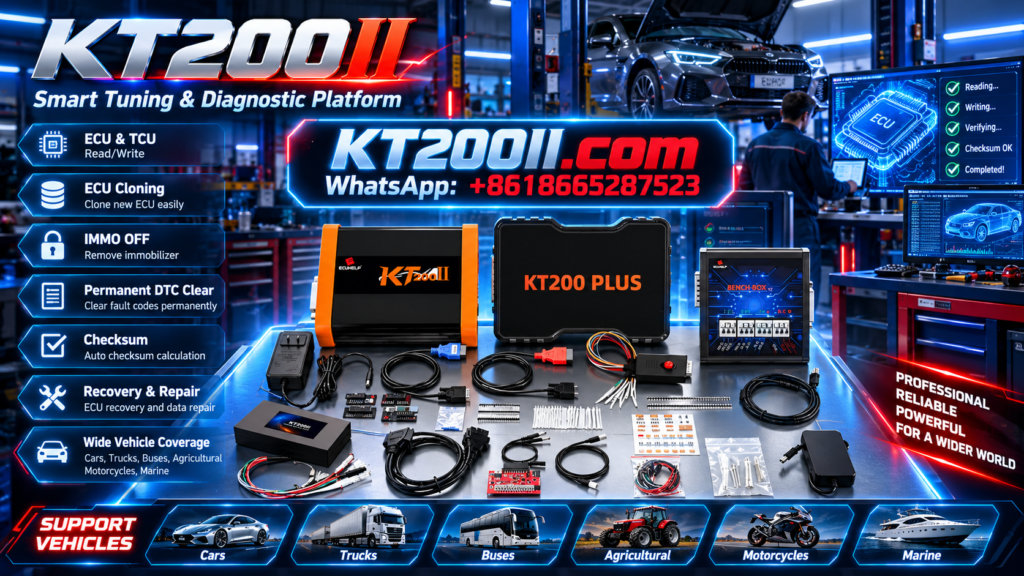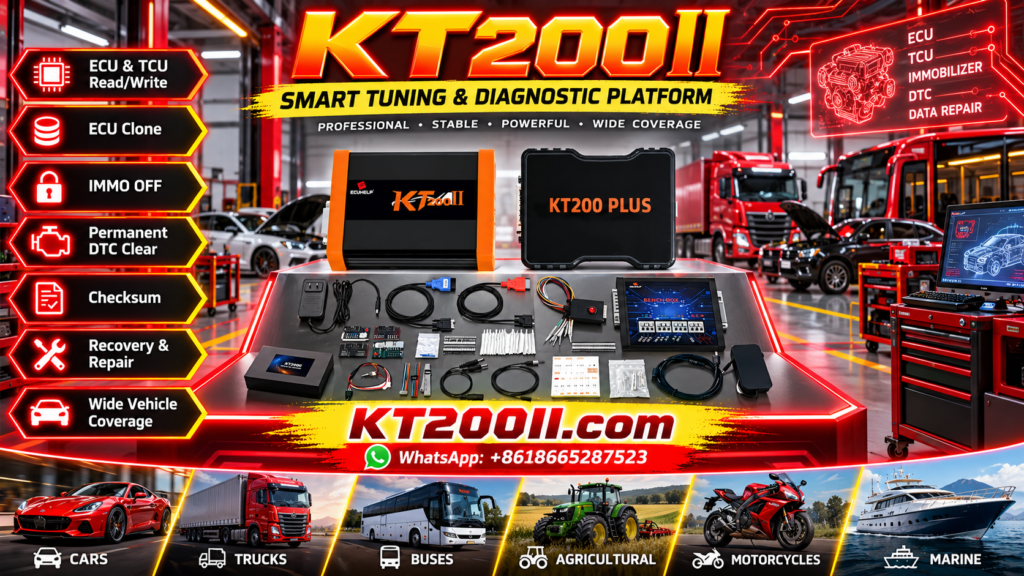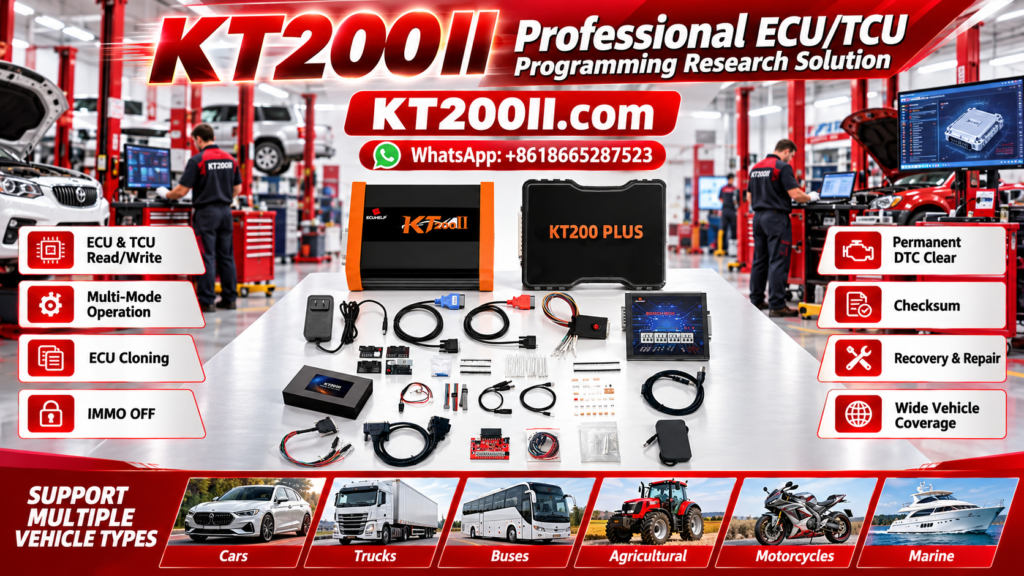
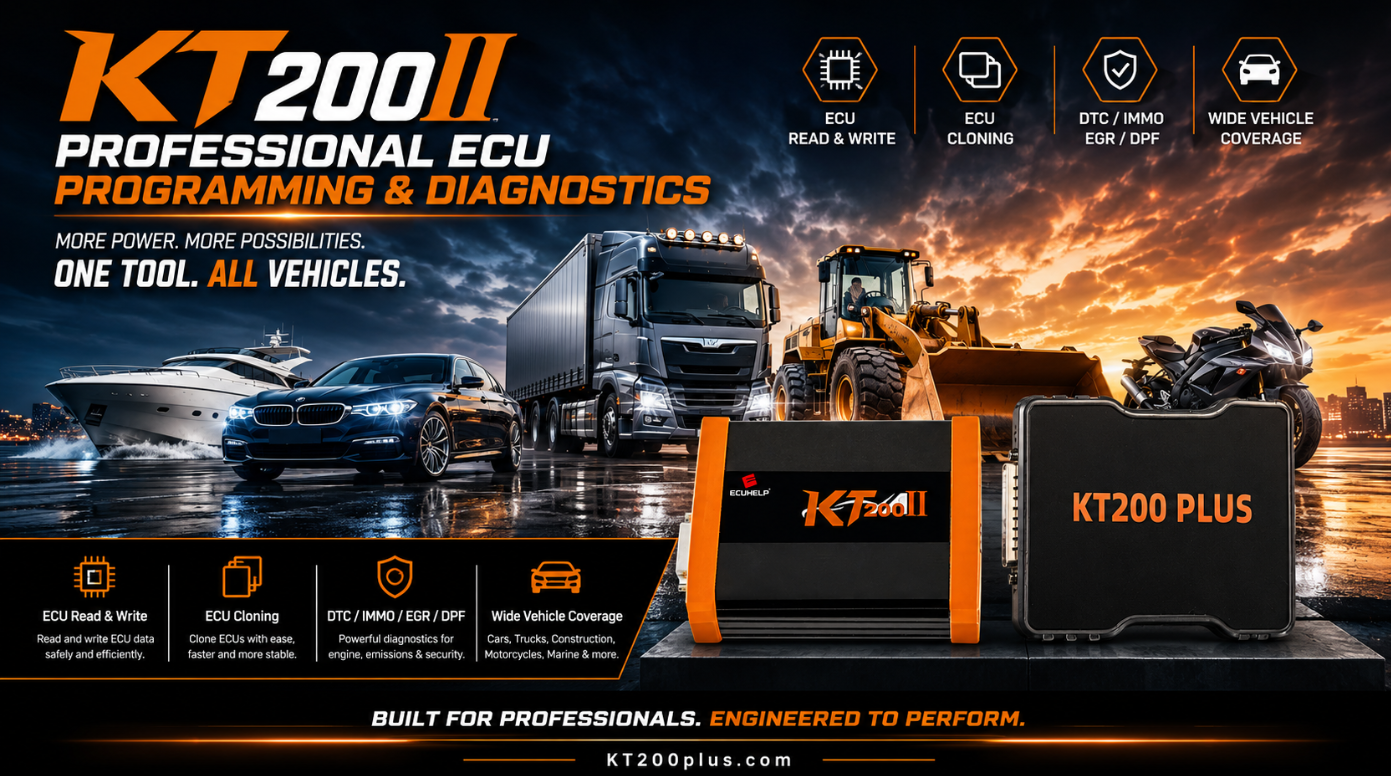
Choosing an ECU programmer should begin with compatibility checking, not with the assumption that one tool can perform every operation on every control unit.
Modern vehicles may use different ECU and TCU manufacturers, processor types, software versions and security systems even when the vehicles share the same model name or engine displacement.
The KT200 Plus supported ECU list helps technicians check whether a vehicle, ECU, TCU, protocol, chip or required operation is included before purchasing the tool or beginning a programming job.
A proper compatibility check can help prevent incorrect protocol selection, unnecessary ECU removal, failed communication and unsafe write operations.
This guide explains how to search the KT200 Plus protocol database, how to interpret the results and which information should be sent to technical support when compatibility remains unclear.
What Is the KT200 Plus Supported ECU List?
The KT200 Plus supported ECU list is a searchable database of compatible ECU, TCU and cloning protocol groups.
It is designed to help workshops identify whether KT200 Plus provides a suitable connection method and operation for a particular control unit.
The current database includes more than 5000 ECU, TCU and cloning protocols that can be searched using several types of information.
Users can begin their search on the KT200 Plus Supported Vehicles page .
A second official search option is available on the HELPECU KT200Plus features and protocol lookup page .
A Supported Brand Is Not Enough
Finding the vehicle manufacturer in a database does not automatically confirm support for every model, engine, ECU, TCU or programming function produced by that manufacturer.
The exact control unit and required operation should always be checked.
Why Compatibility Checking Matters
ECU and TCU programming changes or retrieves data stored inside an electronic control unit.
Selecting an incorrect protocol or connection method can cause:
- Failure to identify the control unit
- Communication errors
- Incomplete reading
- Incorrect file size
- Writing failure
- Corrupted ECU or TCU data
- Loss of the original calibration
- A control unit that no longer communicates
- Additional recovery work
A few minutes spent confirming the ECU type, processor and working mode can reduce many avoidable programming risks.
Search by the exact ECU or TCU whenever possible, not only by the vehicle model.
What Information Can Be Used to Search?
KT200 Plus compatibility can be checked using several search methods.
Vehicle Manufacturer
Search by the vehicle brand when the exact ECU information is not yet available. Use additional keywords to narrow the result.
Vehicle Model
Enter the model name, but remember that one model can use multiple engines, ECUs and transmissions.
ECU or TCU Manufacturer
Search manufacturers such as Bosch, Continental, Delphi, Denso, Marelli, Hitachi or other listed control-unit suppliers.
ECU or TCU Family
A control-unit family such as MED17, EDC17, MD1, MG1, SID, DCM or a gearbox controller type usually provides a more precise result.
Protocol Code
Search the protocol identifier when it is already known from the software, support list or previous programming work.
Chip or MCU
Search by processor or microcontroller information such as an Infineon, Renesas, Motorola or other supported chip family.
Vehicle Search vs ECU Search
Vehicle-based searching is useful when a customer only knows the make, model and year.
ECU-based searching is normally more accurate because the same vehicle can use several control-unit versions.
| Search Method | Useful Information | Limitation | Recommended Next Step |
|---|---|---|---|
| Vehicle Brand | Useful for reviewing general manufacturer coverage. | Produces broad results and may include unrelated ECUs. | Add the model, engine or ECU family. |
| Vehicle Model | Helps narrow results for a known vehicle. | One model may use several ECU or TCU versions. | Confirm the control-unit label. |
| ECU Family | Provides more relevant programming protocols. | One family may contain multiple processors and generations. | Compare hardware, software and MCU information. |
| Part Number | Can help identify a specific hardware application. | The exact number may not always appear in the public database. | Search the ECU family or send the label to support. |
| Chip or MCU | Useful for Bench, Boot and direct programming research. | The processor alone does not confirm the complete protocol. | Confirm the ECU family and connection diagram. |
How to Identify the ECU or TCU Before Searching
The most reliable information normally comes from the control-unit label or the identification screen of a diagnostic tool.
Record as much of the following information as possible:
- Vehicle manufacturer
- Vehicle model
- Production year
- Engine type and displacement
- Fuel type
- ECU or TCU manufacturer
- ECU or TCU family
- Vehicle manufacturer part number
- Hardware number
- Software number
- Processor or MCU type
- Required operation
Take a clear photograph of the ECU or TCU label before removing, opening or connecting the control unit.
Recommended Compatibility Request
Send the vehicle model, production year, engine, clear ECU label photo and the exact operation required, such as read, write, clone, DTC clearing or authorized IMMO service.
Understanding ECU and TCU Results
ECU and TCU protocols should not be treated as interchangeable.
ECU Protocols
ECU protocols generally relate to engine control units and may provide supported reading, writing, identification, cloning or service functions.
TCU Protocols
TCU protocols relate to transmission or gearbox control units. They may use different processors, memory layouts and connection procedures.
When searching for a transmission controller, include the gearbox family, TCU manufacturer or mechatronic type rather than relying only on the vehicle model.
The KT200 Plus Features page provides an overview of ECU and TCU programming capabilities.
Understanding the Available Operation
Finding a control unit in the database does not automatically mean that every operation is available.
A protocol may provide one or more of the following:
- Identification
- Virtual read
- Physical read
- Calibration read
- Flash read
- EEPROM read
- Full backup
- Write
- Clone
- Checksum handling
- DTC management
- Authorized IMMO service
- Recovery for selected control units
Confirm that the required operation appears for the exact protocol before beginning the job.
Read Support Does Not Automatically Mean Clone Support
A protocol may support calibration reading and writing without providing the complete memory access required for ECU cloning.
Check whether flash, EEPROM, MCU or a dedicated clone function is available.
Understanding KT200 Plus Connection Modes
The supported database should also be used to identify the required physical connection method.
OBD Mode
OBD mode communicates through the vehicle diagnostic connector when the vehicle and ECU protocol support it.
It is convenient because the ECU can often remain installed in the vehicle.
Bench Mode
Bench mode connects directly to the ECU or TCU pins in a controlled workshop setup.
The control unit is normally removed from the vehicle, but the housing may remain closed when the protocol supports external Bench access.
Boot Mode
Boot mode provides deeper processor-level access for selected control units.
It may require opening the ECU and connecting to designated Boot, CNF, reset or communication points.
JTAG Mode
JTAG uses dedicated processor programming connections for supported control units and professional repair workflows.
Read the detailed KT200 Plus OBD, Bench and Boot comparison guide before selecting a working method.
How to Use the KT200 Plus Supported ECU List
Collect the Vehicle Information
Record the brand, model, year, engine, transmission and customer’s required operation.
Identify the ECU or TCU
Photograph the control-unit label and record the manufacturer, family, part number, hardware number and software number.
Search the Most Specific Keyword
Begin with the ECU family, TCU type, protocol code or chip rather than a very broad vehicle-brand search.
Review All Matching Protocols
Similar ECU names may appear in more than one protocol group. Compare the processor, vehicle application and connection mode.
Confirm the Required Function
Check whether the result provides the read, write, clone, DTC or authorized service operation required by the workshop.
Confirm the Working Mode
Verify whether the operation uses OBD, Bench, Boot or JTAG and prepare the correct adapter and wiring.
Check Software and Driver Installation
Install the correct KT200 Plus software and dongle driver before beginning professional programming work.
Request Support When Uncertain
Send the vehicle and ECU information to ECUHELP when the public database does not provide a clear result.
What If the Search Shows No Result?
A zero-result search does not always prove that the control unit is unsupported.
The search term may be too detailed, formatted differently or based on a part number not included in the public database.
Try the following:
- Remove spaces, hyphens or unnecessary characters.
- Search only the ECU family.
- Search the processor or MCU.
- Search the vehicle manufacturer.
- Search a shortened protocol code.
- Check whether the unit is listed as an ECU or TCU.
- Send the label photo to technical support.
For a manual compatibility check, contact the ECUHELP Support Center .
What If Several Protocols Look Similar?
Some control-unit families contain several processor generations, hardware versions or manufacturer applications.
When several results appear, compare:
- ECU or TCU manufacturer
- Control-unit family
- Processor type
- Vehicle application
- Protocol code
- Connection method
- Available read type
- Available write type
- Clone availability
- Special connection notes
Do not select the first result simply because the ECU family name matches.
Compatibility for ECU Cloning
ECU cloning normally requires more data access than standard calibration reading.
Depending on the ECU, a clone may require:
- Internal flash
- External flash
- EEPROM
- Microcontroller data
- A complete backup
- A dedicated cloning procedure
The donor ECU must also be compatible with the original unit.
Compare the donor:
- Part number
- Hardware number
- Processor
- Memory configuration
- Vehicle application
- Connector and pin layout
Before writing a donor unit, read and save its original data whenever the protocol allows it.
Compatibility for DTC Clearing
KT200 Plus provides DTC management for supported control units, but DTC clearing should not be treated as a replacement for proper diagnosis.
The correct professional workflow is:
- Read and record the original fault codes.
- Identify the cause of the fault.
- Complete the required repair.
- Clear supported stored fault information.
- Rescan and verify whether the fault returns.
Fault codes should not be removed to conceal unresolved mechanical, electrical, safety or emissions-related problems.
Compatibility for Authorized IMMO Service
Authorized immobilizer-related service availability depends on the exact ECU family and listed protocol.
A general IMMO feature listing does not confirm that every ECU or vehicle is supported.
Before beginning an authorized service job, confirm:
- The exact ECU family
- The supported protocol
- The required connection mode
- The available service function
- The original ECU backup
- Legal ownership or repair authorization
KT200 Plus should only be used for lawful vehicle repair and authorized professional service.
Software Compatibility Is Also Important
The correct ECU protocol also requires the correct KT200 Plus software and device driver.
Using unknown software packages may cause:
- Dongle recognition failure
- Activation problems
- Missing protocol data
- Communication errors
- Unexpected software instability
Download the official installer and driver from the KT200 Plus Software Download page .
Official ECUHELP software and related files are also available from the ECUHELP Download Center .
Common Compatibility-Checking Mistakes
Searching Only by Vehicle Brand
A broad brand search does not identify the exact ECU, TCU or available programming function.
Ignoring the Production Year
A manufacturer may change processors or control-unit suppliers during a vehicle model’s production period.
Confusing Similar ECU Families
Similar names can contain different processors, flash sizes or security structures.
Assuming Read Means Full Backup
A calibration read or virtual read may not include EEPROM, MCU or all data needed for recovery and cloning.
Ignoring the Connection Mode
An ECU listed for Bench or Boot should not be connected using an unrelated OBD procedure.
Buying Before Checking Important ECUs
Workshops should verify the ECUs and TCUs they service most frequently before choosing a programming tool.
Writing Without an Original Backup
Always save the available original data before modifying or replacing a control unit.
Information to Send to ECUHELP Support
When the KT200 Plus supported ECU list does not provide a clear answer, send:
- Vehicle manufacturer
- Vehicle model
- Production year
- Engine or transmission type
- A clear ECU or TCU label photo
- ECU or TCU family
- Hardware and software numbers
- Processor or MCU when known
- The required operation
- The preferred working mode when relevant
Avoid sending only a message such as “Does KT200 Plus support BMW?” A specific compatibility request can be checked more accurately.
KT200 Plus Compatibility Checklist
Confirm These Points Before Programming
- The vehicle brand, model and year are recorded
- The engine or transmission type is known
- The ECU or TCU label has been photographed
- The control-unit manufacturer and family are identified
- The hardware and software numbers are recorded
- The processor or MCU is confirmed where necessary
- The exact KT200 Plus protocol has been selected
- The required read, write or clone function is listed
- The correct OBD, Bench, Boot or JTAG mode is confirmed
- The required cable or adapter is available
- The correct wiring diagram has been reviewed
- Stable power is prepared
- The original data will be backed up
- Technical support has confirmed any uncertain details
Frequently Asked Questions
How many protocols does KT200 Plus support?
The current KT200 Plus database provides more than 5000 ECU, TCU and cloning protocol groups. Exact functions vary by control unit.
Can I search KT200 Plus support by vehicle model?
Yes. The database can be searched by vehicle model, but searching the ECU or TCU family usually provides a more precise result.
Can I search by chip or MCU?
Yes. Chip and MCU information can help identify suitable Bench, Boot or direct-access protocols.
Does a listed ECU always support reading and writing?
Not necessarily. One protocol may support identification or reading, while another may provide writing, cloning or additional functions.
Does KT200 Plus support ECU and TCU cloning?
KT200 Plus provides cloning workflows for supported ECUs and TCUs. Check the exact protocol and donor compatibility before writing.
Where can I buy KT200 Plus?
Product details and ordering are available from the HELPECU official KT200Plus product page .
Where can I ask for compatibility confirmation?
Send the vehicle information, ECU or TCU label and required operation to the ECUHELP Support Center .
Final Thoughts
The KT200 Plus supported ECU list is an important starting point for safe and efficient ECU or TCU programming.
Workshops should search by the most specific information available, including the ECU family, TCU type, protocol code, chip or MCU.
Finding a control unit in the database is only the first step. The user must also confirm the available operation, working mode, adapter, wiring diagram and backup requirements.
When the result is unclear, send the complete control-unit information to ECUHELP before purchasing or programming.
Check Your ECU or TCU Before Ordering KT200 Plus
Send the vehicle model, production year, ECU or TCU label photo, chip information and required operation for compatibility confirmation.
Search the KT200 Plus supported ECU and TCU database .
Review the KT200 Plus programming features .
Download the official KT200 Plus software and driver .
Read common answers on the KT200 Plus FAQ page .
View the HELPECU KT200Plus features and protocol lookup page .
View and order the KT200Plus ECU Programmer .
Download official resources from the ECUHELP Download Center .
Read more articles on the KT200 Plus Blog .
Coverage and available functions depend on the vehicle, ECU or TCU family, hardware version, software version, processor, protocol and selected connection method.
Always confirm compatibility, use stable power and save the available original data before performing a write operation.